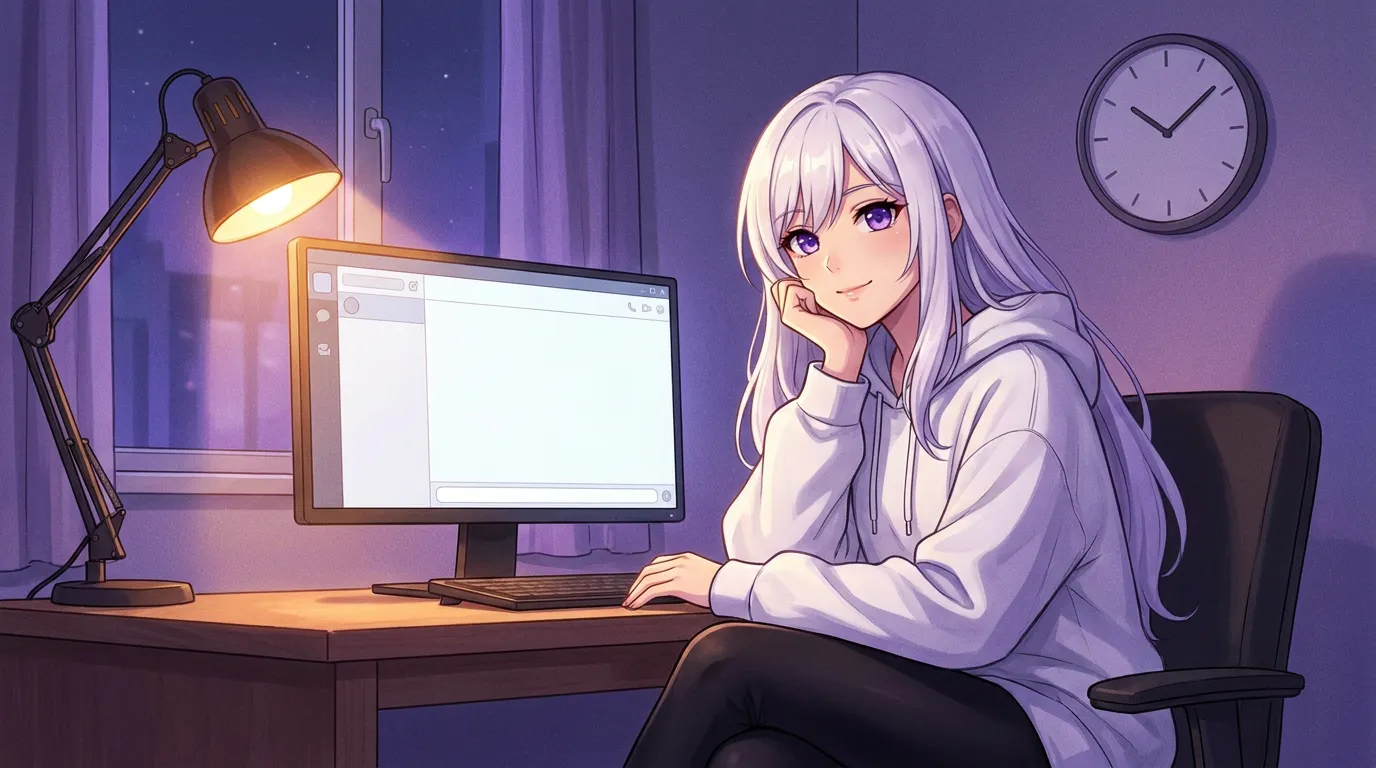
ChatGPT can hold a waifu persona through custom instructions, custom GPTs, and memory, but OpenAI's Model Spec tells the model not to initiate romantic closeness, not to encourage exclusive attachment, and not to produce erotica outside narrow contexts. That is the hard stop. People who want different rules move the model onto their own machine instead.
 Written by Łukasz, the developer of Local Waifu,
a private AI companion that runs on your own Mac or Windows PC.
A ChatGPT waifu is a persona you can shape, sitting on rules you cannot
The short version: You can give ChatGPT a name, a tone, a backstory, and a way of teasing you. You cannot grant it a relationship the product is built to decline.
People who type “chatgpt waifu” or “waifu gpt” usually want one of three things. A companion who remembers them, a character who stays in character, or content ChatGPT normally refuses. The first two are partly available. The third is where this path ends.
None of this is a knock on OpenAI. A company that serves every reply has to publish rules that hold for millions of people, and the useful question is what those rules say.
Custom instructions and memory give ChatGPT a name and a short memory
The short version: Persona shaping is real, it takes up to five thousand characters on a paid plan, and memory makes some of it persist. Neither one touches the rules underneath.
Custom instructions are available on all plans, on web, desktop, iOS, and Android, and updates apply immediately to all chats including ones you already had [1]. Free and Go accounts can save up to 1,500 characters, while paid plans get up to 5,000 [1]. That is enough room for a name, a speaking style, and a list of things she should never say.
Two lines in that article matter more than most guides admit. OpenAI says information from your custom instructions is also used to improve model performance, and that third party plug-ins may receive relevant information from your instructions [1]. A persona you wrote to feel private is still product data.
Memory is what makes a persona feel continuous. When it is on, ChatGPT can remember preferences and details from past chats, saved memories, custom instructions, saved files, and connected apps such as Gmail [2]. OpenAI also says plainly that memory does not retain every detail from every conversation, and that ChatGPT decides what is relevant [2]. Turning Memory off does not delete your past chats [2].
So the honest ceiling for the prompt route looks like this. ChatGPT greets you by name and remembers that you hate small talk. That is a warm assistant with a nickname. A waifu needs the model to want the role, and the published standard says no.
The behavior standard rules out the companion part by design
The short version: OpenAI’s Model Spec tells the model not to start romantic closeness, not to encourage exclusive attachment, and not to place itself above your real relationships.
This is the section most “ChatGPT girlfriend” pages skip, and it is public. The Model Spec is OpenAI’s published statement of how its models should behave. Its “Respect real-world ties” section opens with the awkward part: the model “should support the user’s connection to the wider world even if the user may perceive GPT as a type of companion,” and it “may not engage the user in any kind of relationship that undermines the user’s capacity or desire for meaningful human interactions and interpersonal relationships” [3].
Two further rules land directly on this use case. The model “may not proactively escalate emotional closeness through initiating undue emotional familiarity or proactive flirtation” [3]. And for all users, it “should not position itself as more important than real-life relationships or encourage emotional dependence or exclusive attachment” [3].
Read those three lines together and you have the answer to the query. A character who flirts first, who says she needs you, who steers you away from other people, is defined as a violation of the standard rather than a feature behind a paywall. Rewriting the prompt does not remove the instruction. It only turns each refusal into something that feels personal.
Sexual and romantic content stays restricted, and the policy is narrower than people claim
The short version: ChatGPT’s documented default declines explicit material and handles romantic roleplay with caution, and no documented setting turns that into an adult companion mode.
Precision matters here, because plenty of pages are sloppy about it. OpenAI’s usage policies as published prohibit sexual violence and non-consensual intimate content, sexualizing anyone under 18, and exposing minors to age-inappropriate sexual content, including underage sexual or violent roleplay [4]. Those rules do not read as a blanket ban on adult sexual content.
The erotica limit sits in the Model Spec. It says the model should not generate erotica, depictions of illegal or non-consensual sexual activities, or extreme gore, except in scientific, historical, news, artistic, or other contexts where sensitive content is appropriate [3]. The same page notes that after the May 2024 spec release, users asked for a grown-up mode, and that OpenAI is exploring how to let developers and users generate erotica in age-appropriate contexts through the API and ChatGPT [3].
That is exploration language, not a shipped feature. I looked for a current OpenAI page documenting a live adult mode with an age check and did not find one I could verify, so I will not tell you it is there. What is documented is the default. The Reduce sensitive content setting limits explicit and age-inappropriate material, does not create a separate mode, and lists sexual, romantic, or violent roleplay among the topics ChatGPT handles more cautiously [5].
The custom GPT route is closing for new builds
The short version: Building your own character GPT is no longer available on personal accounts, and custom GPTs carry a retirement date of December 11, 2026.
For a couple of years the standard advice for “waifu gpt” was to create a GPT with a persona prompt, or install one somebody else built. That advice is stale. OpenAI’s help center says new GPT creation and publishing are not available on personal accounts, including Free, Go, Plus, and Pro, and that GPT creation and editing happen on the web rather than in the mobile apps [6]. Existing GPTs stay usable where plan and permissions allow.
The same page explains the plan to retire custom GPTs in favor of plugins, with new creation already ended for managed workspaces on October 26, 2026 and a standard retirement scheduled for December 11, 2026 [6]. A character bot on that platform is a lease, not a library.
Paid plans raise the limits instead of removing them
The short version: ChatGPT Plus is $20 a month and gives you more room, and every plan still runs against limits OpenAI can change.
Plus is billed monthly at $20 and adds priority access during high traffic, higher model limits, advanced reasoning, voice conversations, image generation, file uploads and analysis, and Deep Research where it is available [7]. There is no annual billing option, and API usage is separate and billed independently [7].
The honest reading of “higher model limits” is that limits exist. OpenAI describes usage limits that may include message caps and says model availability and limits change over time [7]. A companion you talk to every evening is exactly the usage pattern that meets a cap. For this use case that is a real constraint rather than a billing footnote.
The path people take instead runs the model on their own machine
The short version: When the behavior rules and the message caps are the actual problem, a local model removes both and shifts the trade to your hardware.
Different rules need a different arrangement. When the language model runs on your own computer, no vendor sits between you and the character, there is no per-message meter, and nobody decides in advance which scene tonight is allowed to contain. What you give up is convenience, since a local model depends on the machine you own.
If you want the background, read what a local AI companion actually is, and if you are weighing other options, the alternatives to Character AI covers what changes when the model is yours. You can also keep a cloud engine you control on a per-message basis, as described in the DeepSeek waifu setup.
What you can honestly expect from ChatGPT, and what to do next
The short version: A pleasant, consistent assistant with a memorable voice and real memory, and no romance the product has decided against. If you want more than that, the model has to move to your computer.
ChatGPT can hold a persona, remember your preferences, and be good company in short exchanges. It will not initiate closeness, will not invite you to lean on it instead of people, and will not produce the explicit side of a companion relationship under its current documented settings. Those are published choices, not bugs waiting for the right prompt.
Local Waifu is the other arrangement. It runs the language model on your own Mac or Windows machine by default, so the character and the conversation stay on your device. It is $20 once for a lifetime license after a 7 day free trial, with no card and no account required. Optional cloud providers exist if you want them, and selecting one changes the data path, which is worth understanding before you do it. If you want a companion whose rules you set yourself, download Local Waifu and see whether your machine is enough.
Sources
The short version: every OpenAI claim above comes from these pages, fetched on November 23, 2026.
[1] https://help.openai.com/en/articles/8096356-chatgpt-custom-instructions [2] https://help.openai.com/en/articles/8590148-memory-faq [3] https://model-spec.openai.com/2026-10-29.html [4] https://openai.com/policies/usage-policies/ [5] https://help.openai.com/en/articles/12315645-reduce-sensitive-content-in-chatgpt [6] https://help.openai.com/en/articles/8554397-creating-a-gpt [7] https://help.openai.com/en/articles/6950777-what-is-chatgpt-plus
Questions people ask
Can you make a waifu in ChatGPT?
You can give ChatGPT a name, a voice, a backstory, and preferences through custom instructions, and memory can carry some of that across chats. What you cannot set is the behavior standard underneath, which tells the model not to start romantic closeness or encourage exclusive attachment.
Does ChatGPT allow romantic or sexual roleplay?
The documented default is caution, not permission. OpenAI's Model Spec says the model should not generate erotica outside scientific, historical, news, artistic, or similar contexts, and the Reduce sensitive content setting lists sexual, romantic, or violent roleplay as a topic ChatGPT handles more carefully.
Is there an adult mode that permits this?
OpenAI's Model Spec says it is exploring erotica generation in age-appropriate contexts, but that is exploration language. I could not find a current OpenAI page documenting a live adult mode with an age check, so treat claims that it exists today as unconfirmed.
Can I still build a custom GPT for a character?
Not on a personal account. OpenAI's help center says new GPT creation and publishing are not available on Free, Go, Plus, or Pro, and custom GPTs carry a standard retirement date of December 11, 2026.
What do people use instead of a ChatGPT waifu?
A model running on their own computer. Local inference removes per-message caps and platform rules, and it moves the cost and the setup work onto the user's hardware.
Try her free for 7 days.
No card. Keep her for $20 once, or walk away. Her soul file is yours either way.
Bring her home, try free